
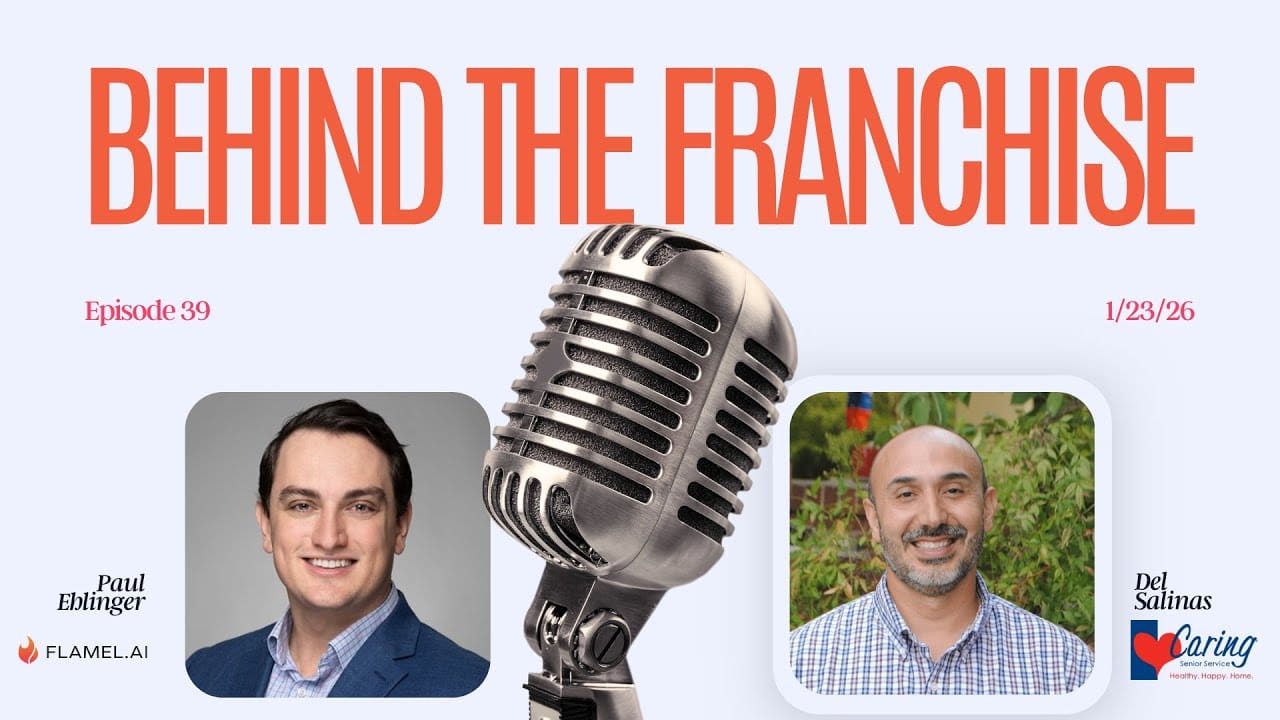
In this episode of Behind the Franchise, host Paul Ehlinger sits down with Del Salinas, Director of Franchise Development at Caring Senior Service, to explore what intentional growth really looks like in a people-first franchise system. With more than 34 years of experience behind the brand, Del shares how Caring has scaled thoughtfully—prioritizing culture, strong owner relationships, and proprietary technology—while staying true to its mission of supporting seniors, caregivers, and franchise owners alike. The conversation dives into franchise development, leadership accessibility, balancing high-tech with high-touch care, and why the legacy of the brand continues to shape its future.
Full Podcast Transcript
Del:
The legacy of the brand is really what our culture comes down to, and it’s that kind of family culture that we have, and a lot of folks have that. We have a strong team. We have a great relationship with our owners. And as trends change, as tech comes into play, we’ve been working with technology in different aspects for decades. We find the best way to balance.
Paul:
Hey everybody and welcome back to another episode of Behind the Franchise. As always, I’m your host, Paul Ehlinger. Excited today have a friend, Del Salinas from Caring Senior Service on the show. Del, thank you so much for joining us.
Del:
Hey, thanks, Paul. Appreciate the opportunity to chat a bit.
Paul:
Absolutely. And for those of the guests who may not be aware of you, if you could, you know, give us your quick background, who the heck are you, and how did you get to where you are today?
Del:
Yeah. Well, Del Salinas. I’m Director of Franchise Development with Caring Senior Service. We provide non-medical home care to seniors where they live or reside. We’re a franchise system and been around 34 years. And I began working with Caring over 6years ago in a different role, working with our Hub department, connecting clients and caregivers with our owners and offices and transitions into the franchise development role, where I get to work with people who want to start their own home care business operating a Caring Senior Service.
Paul:
Yeah. I love that. I mean, talk about meaningful work, right? Like a helping people start their own business, but then the end product is senior services as well. So, like you got to feel good at the end of the day.
Del:
Yeah. It’s great to, you know, have conversations with people that want to, you know, chase their dreams and give an opportunity to follow their dreams and then ultimately to open their business and to start fulfilling their dreams. So, it’s pretty cool to be able to be involved with folks in that capacity.
Paul:
Yeah. No, I love that. And jumping into kind of our first topic of conversation, you know, with your role in franchise development, we were before the call kind of talking about the decision not to use, you know, outside capital to doing uh franchise development in-house. Obviously, they’re taking a very intentional growth period over the last 3 decades. You know, tell us how you guys go about growth like you know how are you guys focusing on adding more units? What does that process look like for you all internally?
Del:
Yeah, so this has been a bit of a progress. The last few years we’ve been focusing on building our headquarters team first to be able to provide the best support we can to new owners. Our focus has always been providing the best care for our clients and the best support for our owners. Being around for over three decades and not being the biggest, you know, bear in the room. We are pushing 60 locations right now, and people always ask, you know, “Why that number, being around so long?” And it’s because we’ve been very successful to provide our owners with what they need the profitability, the opportunity to provide, this business that provides purpose and reward and also to grow strategically with people with the like mindset of ours. And that’s one of our big differentiators is the culture that we have. So, we’ve been working with our team internally to have a very robust team to provide a lot of one-on-one time with our owners, and we’re fully uploaded and rocking out some good candidates right now.
So, we have folks to reach out to us, you know, via online searches currently through different AIs like ChatGPT for example and then other folks that are using support through other means like franchise brokers or other ways to connect.
Then we have a conversation and better understand what our business looks like and what the process looks like and to find out if it’s a good fit. And there’s a lot of folks who are interested in either exiting the corporate world or have had an experience personally—whether good or bad—and want to jump into this business to provide a great experience for somebody else. And people that have been in the healthcare field for decades and have been putting in the hours for other people and other agencies that want to do for themselves now. So, a lot of folks I get to chat with.
Paul:
Yeah. No, that’s exciting. And I think you bring up culture being a really large differentiator for you all. You know, in your role, how are you balancing that? How are you, you know, when you’re interviewing potential zees or owners, you know, what are you doing to confirm, “Hey, these people will be, you know, a good fit and additive to the culture that you guys have built to this point?”
Del:
Yeah, that’s a great question. So, you know, our process is a little bit different than maybe other franchise systems. You know, we’ve been leading technology for a little while. I’ve been doing virtual calls like this way before 2020. And we go through a process; it’s a bit lengthy. The first stage is working with me a lot where it’s a virtual call like this, and we have a chat to understand the why and kind of walk through our business model. But then we shift gears a bit and have them have one-on-one calls with our directors and with our CEO and vice president and give the opportunity to meet our team. And we get to kind of have a mutual evaluation where we get to see if they’re a good fit for us, if we’re a good fit for them, and really have the entire team give feedback on these candidates to make sure that is a good fit before even talking to other owners and getting validation through them. So, it’s a pretty in-depth process which has its pros and cons, right? People have to really invest their time into it, but it’s a lot more flexible for the candidate and gives us a lot more opportunity to have one-on-one conversations with our owners.
Paul:
Yeah. When you know, I’m curious, especially as you have your directors all meeting with a potential zee, like what are some of the more common red flags you guys come across in the process? You know, we were like, “Hey, maybe, you know, we got to reverify this or maybe they really aren’t a good fit for the system.”
Del:
Yeah. It’s people that end up wanting to do their own thing, right? People join a franchise system because of the proven systems and processes, and some people just want to be, you know, entrepreneurs from the ground up and build something, which is awesome. In the process when there’s a lot of push back or a lot of wrong questions, you know, there’s never really a wrong question. But when the question becomes, you know, “Why do I need to do it your way” and then we explain the why then it’s, you know, other ideas usually that that ends up being an opportunity to find other avenues for them and that’s what happens if they end up saying, “Hey Del, it’s not quite what I had in mind.” Because we’re very honest with them and to be successful they need to operate in our processes and usually I get the phone call, text or email just says, “Hey, you know, think it’s not quite the fit I thought in mind,” which is great, right? We want to learn that way earlier in the process than down the road.
Paul:
Fast no’s are the friends, right? You got to love a fast no.
Del:
100% 100%.
Paul:
Yeah. No. Yeah. To everybody out there, somebody is selling you something or going through something, the faster you say no, the better for everybody involved. And you bring up kind of your systems and how you guys have scaled. You know, I imagine over 34 years, the systems have probably adapted quite a bit. And I would imagine with technology as it is today, it’s always adapting. You know, what does that look like when you guys think about kind of maintaining the legacy of the brand while continuing to grow, shift, and change those systems you have in place?
Del:
Yeah. You know the legacy of the brand is really what our culture comes down to and it’s that kind of family culture that we have. And a lot of folks have that we have a strong team. We have great relationship great relationship with our owners. And as trends change as tech comes into play—we’ve been working with technology in different aspects for decades—we find the best way to balance that high tech and high touch. And finding the best way to embrace technology and the best way to utilize that to be more efficient to be faster to you know have better communications with our owners, our teams, and our clients and still have that that family culture fit.
And so as things change, the business doesn’t really change, right? It’s getting caregivers. It’s getting clients to provide care. It’s trying to find the best way to keep the owners and the caregivers and the staff and the clients connected with efficiency and consistency. And so we’ve been able to lead with that and continues to kind of be our north star and what we want to do.
PaulL
Yeah. And I know you guys have like built some proprietary, in-house kind of technology, the home care platform. Maybe walk me through that because I think it’s unusual, right? Like you guys aren’t a massive brand, you don’t have 20 developers on the team. What did that decision look like? And how has that kind of played out for you guys?
Del:
Yeah. Yeah, that’s a big differentiator for us. We have our own software that we created for Caring Senior Service for the home care space. You mentioned that the decades we’ve been in business. Actually, the first decade of business our CEO and founder operated as a private owner. So, he was a private owner operating multiple locations and franchising in 2001 and then using the software everyone uses in hospitals, home health agencies. And it’s great software but it was missing some pieces. It does didn’t have everything that you need for the business. If you can imagine starting a new business and needing software for your invoicing, for your billing, for your clients, for your staff, for marketing, and then they all don’t connect. So we found a way to bring it all together into one system and you use it for everything. It all connects. So, your caregivers come in; they go through the process of being vetted out. You capture all the information you use later on to match them with the client. When the client comes in from the initial lead all the way through providing care, it’s capturing information and guiding you through that you can use later on to match the right caregiver.
And then as technology improves, we can use those data points to make faster matches. We also use that same software for your billing, for your scheduling, for your marketing plans, for your training. There’s a lot of other, you know, hidden fees sometimes that you don’t always see when starting a business because you need all these additional softwares to do the work. And ours allows you to be in one spot. So, it’s a pretty robust system that allows you to be more efficient and like any tool, right? It’s how you use the tool, right? The hammer doesn’t build, right? So, you have to, you know… candidates aren’t really tech savvy or shy away from that, you know, have some struggles. You want to make sure that people are open. It’s user friendly, but you have to use the system, which goes back to the question earlier about when people decide to pivot, “it’s are you confident, comfortable in our systems and processes?” We’re going to show you how to do it. We provide the path. You just got to follow the steps.
Paul:
Yeah. Yeah. No, that’s interesting. And I think it makes a ton of sense why that’s a differentiator as well, you know, when you’re going through like the front dev process, right? If it’s just like, “hey, we’ve lived this problem. We’ve built solutions for this problem. It’s all very specific and to the point.” I’m curious, you know, when you’re when you’re going through the selection process with the zee, you know, what are the value propositions that, you know, you’re selling to them to differentiate you from others in the home care, senior care space? You’re like, “hey, this is why.” What’s really sticking out for folks?
Del:
Yeah, there’s 3big differentiators that I talk about. One I touched on a while ago. You know, our CEO and vice president both still own and operate multiple offices. You know, many of our competitors are private equity, and we still have our hands in the business. We’re still talking to caregivers daily, clients, our office teams. And we bring that experience to our owners and can talk about that. And that really keeps us true to who we are, which goes back to providing the best care for our clients and the best support for our owners and can speak to that. And as things change in different states or in a national level, you know, we’re able to speak to that because we’re dealing with that in real time.
Also, the opportunity to talk to your CEO and vice president at the drop of a hat. You know, I’m not sure how many large companies you can reach out to and text or call your CEO and vice president to have a chat and to get feedback. That’s how close we are with our owners. We chat with owners pretty regularly whether it’s via teams or via phone call or email and have that relationship which is a big differentiator to be able to have that support from your highest leadership.
Second is our process for providing care. We have a system called GreatCare that walks you through step by step on those three parts of the business I talked about a little while ago: caregivers to clients and providing care. And so combined with our technology, the software that we use, it really gives you a whole package of how to run the business. You’re walking into the game plan already set. We give you, you go and knock it out, but you’re not by yourself, right? You always have the robust team I talked about. So now when you’re going through our process of meeting our directors and seeing how we work with our owners and then you’re up and running and you’re like, “Oh, I remember talking with these folks and them walking me through this.” And now having a relationship where you’re working with our headquarters team on day-to-day operations and better understanding how to execute that. So that when light bulb goes off like, “Oh okay I get it now. We can move forward with it.”
So yeah, those are our big differentiators there is the level of experience we have, the plan to execute your business with our technology and the support team that is right there with you every step of the way.
Paul:
Yeah. No, it makes a ton of sense. And I know in your time, you know, you’ve kind of transitioned from Hub services uh into franchise development. I’m curious, you know, for you, what was that transition like, right? Like taking on that differentiated role? How has it been for you taking that over? I mean, it’s a crucial part of any franchise, right? It’s a hyper important role.
Del:
Yeah, it actually worked out really well. Working with owners and offices and the office staff for years on getting caregivers. So, the whole recruitment process. It kind of went hand in hand in 2020 when everyone was going virtual. They gave us an opportunity to really flex what we do techwise. So, you bring a caregiver on from apply all the way through scheduling the caregiver doing a lot of things virtually. We do want to get eyes on the candidate, right? You do want to validate presentation, right? You want to validate good hygiene. So, these are things you want to see in somebody. But being able to bring a caregiver from, you know, apply all the way through, having those conversations and then talking with the office team, providing that assistance and having a real understanding of what that looks like allows me to speak to that with other candidates. And then from the flip side on the client, when people call in or reach out via online, they talk to our Hub team. And so to have that initial conversation with somebody’s, you know, spouse or parent or child that’s just trying to understand what’s going on with options when they’re trying to bring their loved one home, having that initial conversation and then walking them through our process to the in-person assessment with our director or owner and then providing care and then being able to explain the process of our caregivers because they want to know, “how do you get your caregivers and who’s gonna be caring for mom?”
So ,walking them through all that and then translating that to this franchise development side and walking through somebody to explain, “hey, this is what your day is going to look like. This is what this role is going to look like. These are the actual daily tasks that need to get done to be successful.” It put me in a real good position to speak to that.
Paul:
Yeah. And I’m I’m curious. So you have a history in like the restaurant space. And when I think about the restaurant world, it’s pretty much chaos. It’s controlled chaos is what it feels like, right? Like how much of that have you brought into this role, right? Where it’s just like managing people all over the place, having different levels of clients, employees, all this stuff — like what have you brought with you up into this that’s making you successful?
Del:
Yeah. Exactly what you talked about. S staffing has always been an urgent need in in the restaurant space. It’s an urgent need in any business and that does translate. The volume of people wanting to work is there. There’s no recruitment shortage anywhere. It’s the retention shortage. It’s how you treat people when they apply and a lot of hourly workers don’t always get the professional courtesy or respect from management.
So, we want to provide our owners education to be good managers, good leaders, good operators to bring on the people. And I’d say our owners are top-notch with that. They do have that passion for servant leadership. That translates very well because you’re dealing with people who have families who have outside of work issues and you have to work with them, right? Um yeah, now more than ever, the employee is just as important, if not more so, than the client. And that’s something that translates over is providing that professional courtesy, professionalism, that dignity to the hourly workers to let them know, “hey, you know, I wouldn’t be here without you.” And that translates 100% into this business.
Paul:
Yeah, it makes a lot of sense. And I’m curious, you know, we’ve talked a lot about kind of how you’re selling within the development process. How much are you talking about the market? Like I was doing some reading beforehand and it’s like apparently 1 in 6 people in the US is over the age of 65. It’s the fastest growing demographic segment. Senior care is going to be is already but is going to be an even bigger industry. Like how much are you leaning into those macro trends, you know, as you’re explaining the opportunity?
Del:
Yeah, quite a bit. That’s just that’s just a fact is that as we continue to age: we’re going to need more. I mean, there’s nowhere in America with home care businesses. It’s a huge need and as this trends in in bigger ways, you know, we have to be able to move with those trends. And that includes providing information for our services. Nobody talks about home care until you need it, right? You’re not taught in 30s, 40s, 50s, 60s, “hey, you might need the service for mom and dad or for yourself in the next 10 years.” It’s always, “hey, mom or dad had a stroke, had a heart attack, had an injury, had a fall, they’re ready to come home now, but they can’t be by themselves.” Either they live by themselves already, or the spouse can’t care for them the way they need to. They can’t operate their limbs like they should. So, who’s going to bathe them, toilet them, make meals for them, be around? And this is all brand new. And if you can imagine the stress people go through just through that part of dealing with those illnesses or when those things happen. Now coming to tap to get someone to care for their loved one. It’s all brand new and it can be emotionally fatiguing, you know, stressful. So, it’s always in the moment that you’re talking to somebody who’s trying to find out and navigate what is this business that you do. How does it work? Everything from who’s providing care to who’s paying for it.
And so, yeah, I say quite a bit to say this is a big need and we have the experience to walk you through how to be successful.
Paul:
Yeah. No, that that makes a ton of sense. And I’m you know I’m curious um with that right like, especially thinking you know you guys have been around for 3 decades there’s this massive market opportunity in front of you. What does growth look like for you in the next 5 years? Like what are your goals what are you focusing on, you know, as you guys do attack this really big opportunity?
Del:
Yeah, so it’s maximizing the opportunity, maximizing capacity, but still keeping true to our culture, which is providing the best support for our clients and for our owners. And going back to the development and growth of our internal team to do that. We’re able to bring on, you know, 3 to 5 candidates a quarter to provide that that continuity of support and not miss a beat. And as we grow in scale, becoming more efficient ourselves, what we’re doing, and then providing more opportunity for our owners. So, it’s quite aggressive what we’re looking at. We put ourselves in a position to continue to provide that consistent support.
Paul:
Yeah. No, it makes a lot of sense. And when I’m thinking about, you know, the tactics of your job, right? Like there’s a million ways to reach potential franchises. What are the what are the pillars you lean heavy on? Are you guys running a lot on LinkedIn? Are you partnering in local communities? What are the pillars you lean on as the Director of Franchise Development?
Del:
Yeah, right now it’s online search. That’s what we’re leaning heavily in right now. It’s a lot of volume and repetition and so a lot of folks are searching for information starting their own their own businesses. We do leverage different consultants and do leverage different portal spaces but kind of as an addition, you know. The volume that we get the majority is from, you know, online lead search. You know LinkedIn is minimal as well. Social media is also a big one that we leverage on and with the growth of AI and different, you know, virtual chats people are leaning more to that as well. And so we spent a lot of time with that volume coming. And then it’s a lot of, you know, getting the reps of, you know, talking to folks and whether they’re calling in or we’re calling out, getting them on the phone and have a chat to better understand what they’re looking for if it’s a good fit.
Paul:
Yeah. Yeah. How does AI play within the org? Because I think as an old brand, like AI is like a fifth evolution of technology that, you know, y’all have experienced in the last 30–40 years. Like what do those conversations look like for you guys?
Del:
Yeah, that’s a good question. That’s top of mind right now because as it grows, you know, we have recently established some criteria and guidelines internally for our corporate offices as well as our owners to stay ahead of that. Because there can be some inaccuracies in what AI tells you. It’s a great tool to do some mundane tasks and to keep you informed as far as like your day and some minor research, but you have to validate and go through those steps and channels. So, we make that part of our process to again educate our owners, educate our teams on how to use it appropriately.
Then from the consumer side, there’s data that’s being, you know, straight from every source digitally. It provides them with similar information. That’s not always accurate. And so it’s being able to speak to it and get ahead of that to understand what they’re seeing before they see it and answer the questions that that brings up. And you know, it’s been pretty good. A lot of folks are doing a lot of leg work using different chat systems, which can provide you a ton of information.
Paul:
Yeah. Yeah. No, I love hearing that. I think like being proactive about it and giving zees guidance is so important because I mean they’re reading the business news as well, right? They’re seeing AI in every single headline that’s coming across their phone. I think it makes a big difference just kind of to lead that up front. I’m curious how you guys handle it because I think it goes a lot of different ways. But you know, let’s say a zee is testing a new AI tool out or trying a new thing. Like, how do they go about bringing that to you? How do you guys go about examining, you know, innovative new solutions or making those decisions as a system?
Del:
Yeah, good question. We brought on recently a new CTO, Justin McAcoo who has a lot of experience in this space and we have regular conversations with our owners. We have monthly town hall calls and they’re all virtual. We started this back almost 5 years ago. It’s brought a ton of tremendous value to our owners to stay ahead of, you know, national updates as well as state updates as well as anything with tech or in the home care space. And so we are usually ahead of most conversations to give this direction.
So when someone has an idea, we want them to share it with us so we can look at practicality and how we can use that appropriately. And then we will run tests internally ourselves to get permission to approve something or disapprove of it. So, we do have processes in place where we welcome, you know, people to experiment and share with us so that we can make sure we’re covering the guidelines that we need to.
Paul:
Yeah, makes a ton of sense. And I I mean I love even that you guys have hired a CTO, right? Like I think it’s probably unusual for a brand of your size to already have a CTO, but it really like stays true to what you guys are talking about of like build that internal support system so that as you grow there’s no surprises. We’re ready for scale, all that good stuff. Like it’s just it’s a through point. You guys clearly live by it.
Del:
Yeah. Yeah. It gives us a good opportunity to stay ahead of the game and there’s just so much that you can do in the technology space that allows us to continue to invest in that. So, at the end of the day, we’re getting back to providing the best care for our clients, the best support for our owners.
Paul:
Yeah. No, I love that. Coming to a wrap on our episode, Del, like I think this was fantastic. I appreciate you kind of walking us through, you know. I love how you guys are building the system, how you build the culture. I think it really comes through in everything you guys are doing and how you’re making those decisions. But for the audience, you know, where can they find you? Where can they learn more about Caring and all of that good stuff?
Del:
Yeah. So caringfranchise.com is where you can find information about the franchise system or caringseniorservice.com. We’re also in social on LinkedIn as well as other social medias like Facebook as well. So anywhere they’re looking information simply Caring Senior Service will pop up and if they’re interested to learn more ,they can reach out. I’d love to have a chat anytime.
Paul:
Awesome. Well, thank you so much Del for your time today. I’m sure everybody else appreciates it as much as I did.
Del:
Awesome. So, it’s my pleasure. I appreciate the opportunity. Thanks, Paul.